


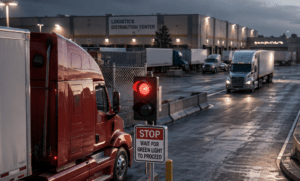
Truck yards combine large vehicles, tight turning areas, loading activity, pedestrians, equipment, gates, and changing traffic patterns. Effective truck yard safety systems help people understand who should move, who should wait, and when a vehicle is approaching an area with limited visibility.
A strong yard-safety plan is not simply a collection of signs. It is a coordinated approach that considers traffic flow, detection, warning timing, vehicle height, blind corners, and the people working around moving trucks. This guide outlines practical questions for distribution centers, manufacturing facilities, fleet terminals, municipal yards, and other commercial sites.Start with the actual movement of the yard
Draw the routes used by inbound trucks, outbound trucks, employee vehicles, forklifts, yard tractors, visitors, and pedestrians. Pay attention to locations where those routes overlap. A site plan may suggest a clean traffic pattern, while daily operations reveal queueing, shortcuts, blocked sightlines, and temporary loading zones.Walk the yard during a busy operating period and note:- Blind building corners and narrow passages
- Single-lane approaches used by traffic in both directions
- Low canopies, doors, bridges, pipes, and overhead equipment
- Gates where vehicles queue into another travel path
- Pedestrian doors opening near active lanes
- Areas where trailers or containers block visibility
- Changing conditions during nighttime or shift changes
Operational insight: The best safety system supports the traffic rules employees already understand. If drivers cannot tell why a light or warning sign activated, compliance usually becomes more difficult.
Four common truck yard safety applications
One-lane traffic control
Red/green traffic lights can manage opposing vehicles through narrow ramps, gates, drive aisles, or building passages. Detection and control logic should account for queue length and the time required to clear the lane.Blind-corner warning
Directional motion detection can activate a warning sign before a truck or forklift reaches a hidden intersection. The sign should identify the actual hazard rather than relying on a generic flashing light.Overheight protection
An overheight detector can identify a vehicle that may contact a canopy, door, bridge, or utility. The warning must be positioned where the driver still has a safe place to stop or redirect.Pedestrian awareness
Vehicle-activated or pedestrian-activated signs can warn people near employee entrances, crosswalks, and dock areas where equipment movement is frequent.Designing traffic-light control for a truck yard
A traffic-light system needs more than two signal heads. The controller must know when each vehicle arrives, when the controlled lane is occupied, and when it is clear to release the other direction. The design should also address what happens after a power interruption or unexpected activation.Questions to answer before selecting equipment
- Is the controlled route one-way, two-way, three-way, or four-way?
- How many vehicles could queue at each approach?
- Can trailers extend beyond the detection area?
- Is a fixed clearance time sufficient, or is presence detection needed?
- Should signals be flashing or continuously illuminated?
- Are manual controls, gate inputs, or emergency overrides required?
Overheight detection needs an escape plan
An overheight warning is most useful when it activates before the driver is committed to the restricted path. The detector location, sign location, stopping distance, and alternate route should be planned together. The system should also account for suspension movement, uneven pavement, antennas, refrigeration units, and other equipment that may extend above the main vehicle body.The VTT1812 vehicle overheight warning kit is designed to provide a clear illuminated warning when a tall vehicle is detected. A site-specific review helps determine the appropriate detector mounting height and warning position.Choosing detection for outdoor industrial sites
Truck yards can create demanding conditions for sensors. Rain, dust, vibration, moving doors, nearby lanes, reflective surfaces, and long vehicle bodies all influence performance. Before selecting a detector, identify the target, detection direction, required range, mounting surface, and nearby movements that should not activate the system.Different applications may call for motion detection, presence detection, loops, photoelectric beams, or gate-control inputs. Compare the available vehicle and pedestrian sensors and test the proposed mounting location whenever possible.A repeatable truck yard safety review
- Map every routine vehicle and pedestrian route.
- Identify conflict points and restricted-clearance locations.
- Rank each location by visibility, frequency, and available reaction space.
- Document existing gates, controls, power, conduit, and network resources.
- Choose a warning message that describes the hazard clearly.
- Select detection that responds to the intended target and direction.
- Set timing based on real vehicle movement—not assumptions.
- Train supervisors on normal operation, testing, and troubleshooting.
- Review the system after traffic patterns or facility layouts change.