

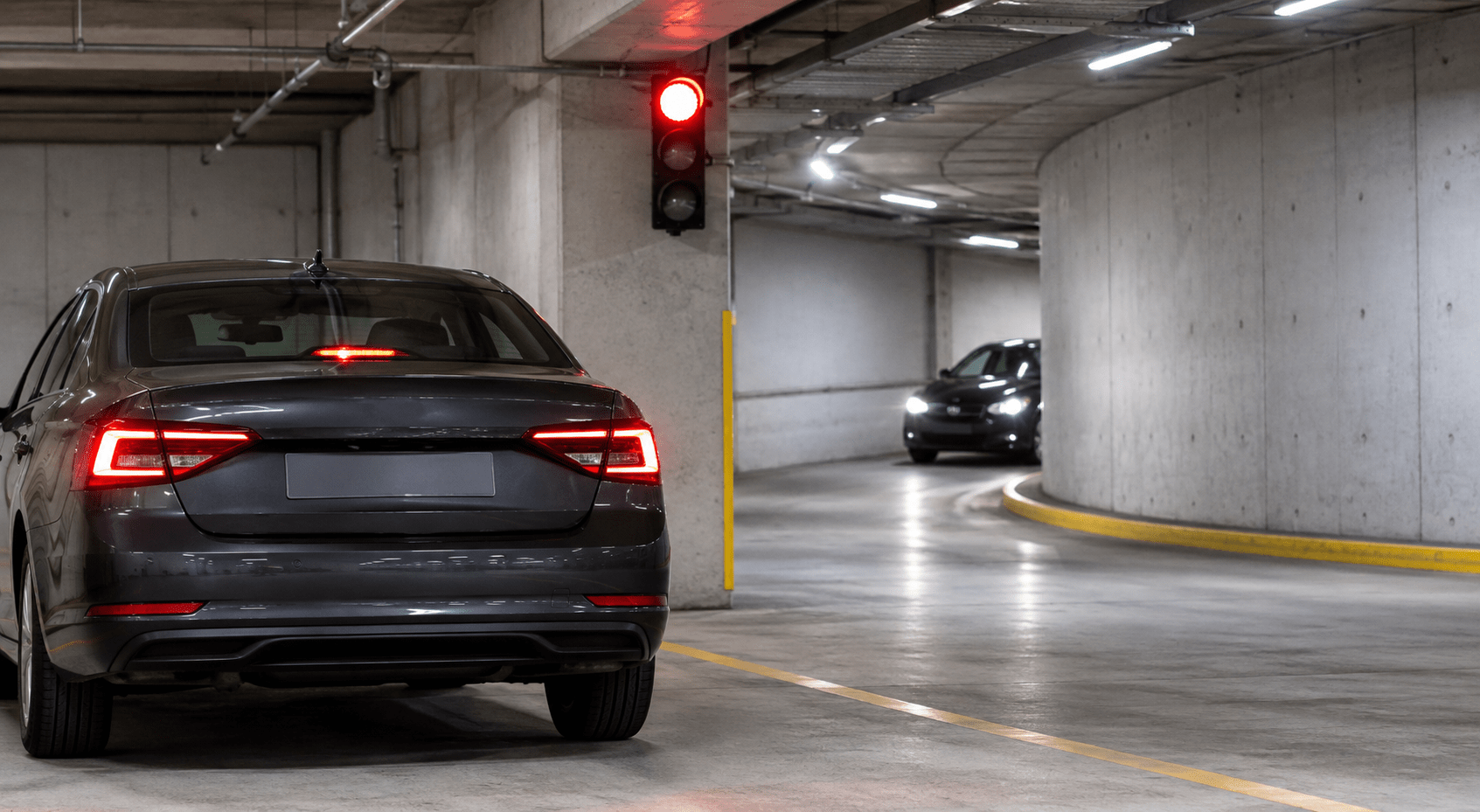
Blind corners in parking garages can turn an ordinary drive aisle into a conflict point. When drivers approaching from opposite directions cannot see one another, a two-way red/green traffic control system provides a clear right-of-way before either vehicle enters the narrow passage.
This guide explains how the RG1006-2Way Traffic Control System can help organize vehicle movement around blind corners, single-lane ramps, and other restricted parking areas. It also covers the site details that matter most when planning detection, signal placement, timing, and commissioning.
Why blind parking garage corners create collision risk
Concrete walls, columns, elevator cores, parked vehicles, and tight ramp geometry can block a driver’s view until the front of the vehicle is already inside the shared lane. Mirrors can improve awareness, but they still require each driver to look in the correct direction, interpret the reflection, and decide who should proceed.
The risk becomes greater when the passage is too narrow for two vehicles to meet comfortably. Drivers may reverse, stop inside the curve, mount a curb, or make an uncertain right-of-way decision. A clear red or green signal removes much of that uncertainty by assigning movement to one approach at a time.
How the RG1006 two-way system works
The RG1006-2Way-Kit is an engineered traffic control system for two opposing approaches. The complete kit includes two RG1006 12VDC red/green LED traffic lights, a PSC-6 central controller with a PS126A power supply, and two Decider2 intelligent vehicle motion detectors.
If a vehicle arrives at the opposite approach during an active cycle, the PSC-6 can queue that request and release it after the current green cycle ends. This sequencing is especially useful where drivers cannot communicate visually through the corner or passage.
Where two-way traffic control is most useful
A two-way system is a strong candidate when opposing vehicles share a constrained path and visibility is limited. Common applications include:
- Blind 90-degree corners inside parking garages
- Single-lane entrance and exit ramps
- Narrow drive aisles between structural columns
- One-lane passages through mixed-use or residential buildings
- Loading areas where trucks and passenger vehicles share a controlled route
- Service corridors with limited turning clearance
A warning-only device tells drivers that a hazard may exist. A two-way traffic light system goes further by providing an explicit stop or proceed instruction for each approach. That makes it useful where the operating goal is controlled sequencing rather than general awareness alone.
Planning detector placement
Reliable operation begins with correct detection. Each detector should see the intended approach early enough for the controller to display a stable signal before the driver reaches the stopping point. It should also avoid detecting vehicles in nearby parking spaces, cross aisles, or unrelated travel lanes.
Questions to answer during the site review
- Where is the last safe stopping point before the blind area?
- How far is that point from the detector’s intended location?
- Will adjacent traffic or parked vehicles enter the detection zone?
- Does the mounting surface allow the detector to aim at the target lane?
- What is the slowest reasonable travel time through the controlled passage?
- Can conduit and low-voltage wiring reach both lights and both detectors?
The RG1006 kit includes Decider2 intelligent vehicle motion detectors. Other projects may use a compatible loop or focused motion detector when site conditions require a different activation method. Review the available vehicle detection sensors when comparing installation options.
Positioning the red and green traffic lights
Each RG1006 light should be visible before a driver enters the controlled area. Mounting it too close to the corner can cause the driver to reach the conflict point before fully recognizing the indication. Mounting it too far away may make the signal appear unrelated to the lane it controls.
Use a clear stop location and verify the signal from normal driver eye height. Check for interference from columns, overhead piping, parked vehicles, glare, and changing daylight at garage entrances. The red indication should direct the driver to wait outside the shared passage, not inside it.
Setting the traffic-control timing
The programmed green time should account for the controlled distance, expected vehicle speed, turning movement, and the possibility of larger or slower vehicles. The objective is to give the active direction enough time to clear before the opposing approach receives a green indication.
During commissioning, test the system from both approaches using realistic travel speeds. Confirm that a second request is recognized, queued, and released in the correct order. If conditions vary significantly by vehicle type, base the timing on the vehicle that reasonably requires the longest clearance time.
Blind-corner traffic control commissioning checklist
- Confirm both approaches begin with an unambiguous signal condition.
- Drive each approach separately and verify the correct light changes.
- Trigger both approaches and confirm conflicting greens cannot occur.
- Verify the waiting request is released after the active direction clears.
- Test the slowest expected travel time through the passage.
- Check detector aiming for unwanted activation from nearby traffic.
- Verify signal visibility during daytime and nighttime conditions.
- Document detector positions, controller settings, and final timing values.
Frequently asked questions
Can the RG1006 system control a blind parking garage ramp?
Yes. The two-way configuration is designed for opposing vehicle approaches at shared lanes, ramps, blind corners, and controlled passages. Final placement and timing should be based on the actual distance and geometry of the site.
What happens when vehicles arrive from both directions?
The PSC-6 controller can hold the conflicting approach at red, queue its request, and release that direction after the active green cycle is complete.
Is a convex mirror still useful?
A mirror may provide helpful supplemental visibility, but it does not control right-of-way. A red/green system gives each driver a direct instruction. Site markings, speed controls, mirrors, and traffic signals can be used together as part of a broader safety plan.
Need help designing traffic control for a blind corner?
Send us photos of both approaches, the controlled distance, available mounting locations, and a simple site sketch. PASS Signs can help configure the RG1006 two-way system for your parking garage or controlled vehicle passage.
Traffic control equipment should supplement appropriate site engineering, signs, markings, speed management, and operating procedures. Confirm final installation requirements with the responsible facility professional and applicable local authorities.