

5 Ways to Create Safer Pedestrian Walkways Inside Parking Garages
Parking garages force people and vehicles to share a compact environment. Drivers are watching for open spaces, turns, gates, and approaching traffic while pedestrians may be walking toward elevators, stairwells, vehicles, or building entrances. When those paths are not clearly defined, a routine walk through the garage can become an avoidable conflict.
A safer garage begins by giving pedestrians a route that is easy to recognize and giving drivers a clear visual boundary they understand immediately. The following five improvements can help parking owners and operators create that separation without relying on a single sign or one safety measure.
1. Map the Routes People Actually Use
Begin by observing how people move through the facility. The safest route on a drawing is not always the route pedestrians naturally choose. Identify the paths between parking spaces and elevators, stairwells, lobbies, payment stations, loading areas, and street exits.
Pay particular attention to blind corners, the ends of parking aisles, ramp entrances, backing zones, and places where pedestrians unexpectedly enter a drive lane. Incident reports, customer complaints, security observations, and near-miss reports can help reveal problems that are easy to overlook during a quiet inspection.
Operational benefit: Defining the real movement pattern allows the facility to spend its safety budget where it can reduce the most risk.
2. Create a Continuous, Clearly Painted Walkway
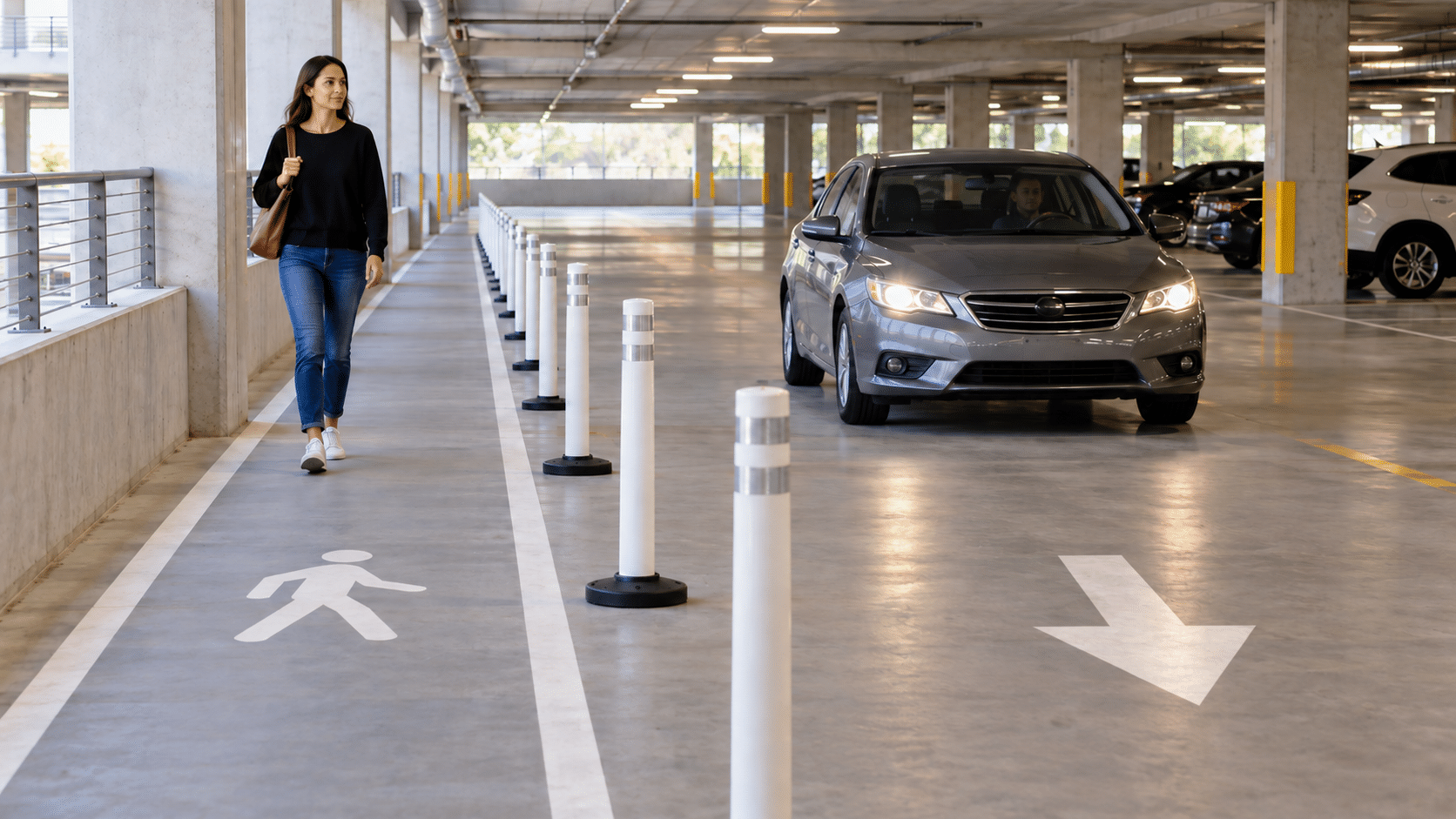
Use high-contrast paint to establish a pedestrian route that remains visually continuous from origin to destination. Two clear boundary lines, pedestrian symbols, directional arrows, and repeated walkway markings tell people where to walk and alert drivers that the space is not part of the travel lane.
Avoid routes that disappear at columns, abruptly end at ramps, or force pedestrians back into traffic without warning. At unavoidable crossings, change the pavement treatment or use bold crosswalk markings so the transition is obvious from both directions.
Operational benefit: A consistent visual system reduces uncertainty and makes the intended path understandable to first-time visitors as well as regular users.
3. Reinforce the Boundary with Flexible Delineator Posts
Paint communicates the route, but vertical traffic delineation makes the separation much harder to ignore. Flexible delineator posts placed along the walkway edge create a visible buffer between pedestrians and moving vehicles while preserving sightlines through the garage.
Use reflective bands for low-light visibility and space the posts closely enough that drivers perceive a continuous boundary. Placement should allow adequate pedestrian width and should not interfere with accessible routes, doors, vehicle turning paths, drainage, or emergency access. Flexible posts are especially useful where a permanent concrete barrier would be impractical.
Operational benefit: Physical delineation reinforces driver behavior, discourages vehicles from encroaching on the walkway, and improves the visibility of the pedestrian zone.
4. Add Sidewalks or Protected Refuge Areas Where Feasible
In higher-risk or heavily traveled areas, a raised sidewalk, curb, guardrail, or protected refuge area provides stronger separation than paint alone. These improvements are particularly valuable along busy drive aisles, at garage entrances, and near elevators or pedestrian doors where people may gather.
When a complete sidewalk is not practical, consider shorter protected sections at the most exposed locations. A refuge area near a crossing gives pedestrians a defined place to pause and check traffic before entering another lane.
Operational benefit: Structural separation can provide a durable long-term improvement in locations with frequent pedestrian activity or recurring vehicle encroachment.
5. Actively Warn at the Points Where Paths Must Cross
Even the best walkway eventually crosses a vehicle route. At these conflict points, combine lighting, sightline improvements, clear instructions, and active warnings. Sensor-activated signs can alert drivers when a pedestrian is present or warn pedestrians when a vehicle is approaching from a ramp, blind corner, or garage exit.
Unlike a static sign that is always present, an intelligent warning activates when the condition exists. That change attracts attention and gives the message greater urgency. Audible alerts may also help at locations where a person could be looking away from the approaching vehicle.
Operational benefit: Earlier, event-based warnings create more reaction time, help reduce warning fatigue, and address the exact moment when a collision is most likely to occur.
Build a Layered Pedestrian-Safety Plan
No single treatment eliminates every risk. The strongest approach combines route planning, visible pavement markings, physical delineation, protected walking areas, good lighting, and active warnings at unavoidable crossings. Together, these measures can help reduce close calls, protect lives, improve traffic flow, and demonstrate that the facility is addressing known hazards responsibly.
Walk the routes regularly after changes are installed. Replace damaged posts, refresh worn paint, keep warning signs visible, and adjust the design when traffic patterns or building use changes.
Need help at a blind crossing or shared vehicle path? Explore pedestrian detection systems and collision-avoidance systems, or contact Pass Signs for help planning the warning portion of your garage-safety system.